
Eldercare is overtaking childcare. Governments and employers need to step up.
Stephanie Bedner has spent the last 10 years caring for her mom, who has Huntington’s disease, a rare genetic disorder that leads to a decline in cognitive function and causes mood disturbances and uncontrolled movements.
Her mom, 65, has been in hospice care for about a year, and her care demands additional help from Bedner’s sister and aunt. Bedner, who is employed full-time in the insurance industry, said she often works late hours to offset the time she spends overseeing her mom’s care.
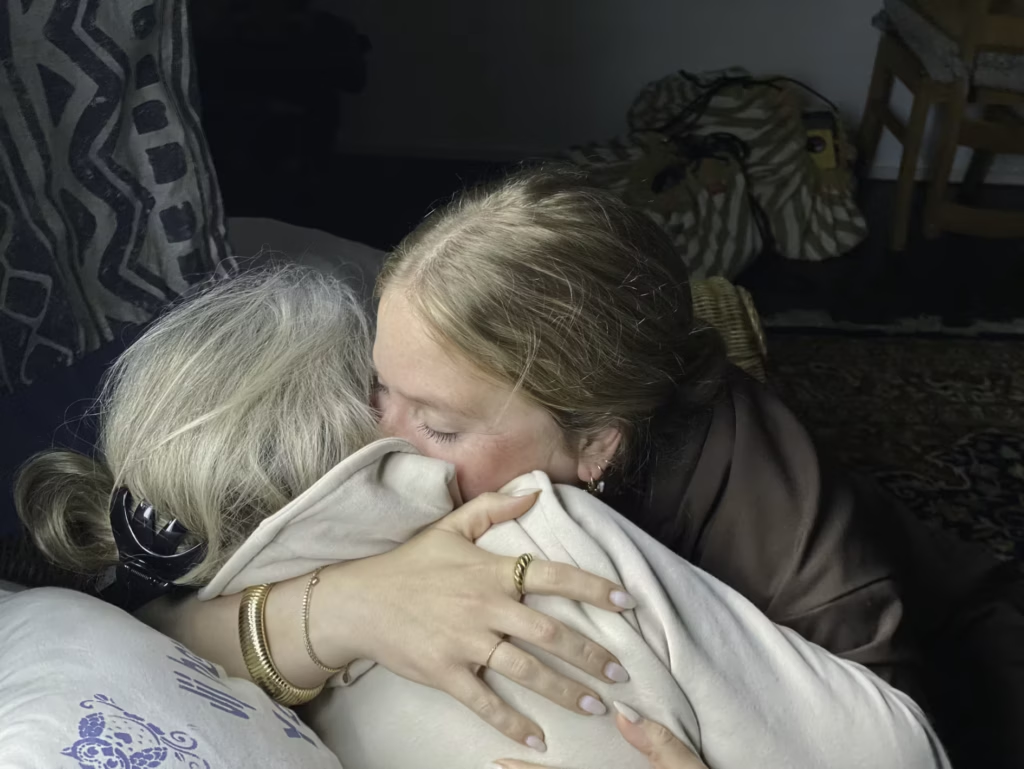
“It’s a constant thought. Is today going to be the day she takes another fall? It’s absolutely heart-shattering to watch a loved one go through this,” Bedner told MarketWatch.
Bedner tries to balance the demands of her job and her caretaker responsibilities with the help of 80 hours per year her company provides for caregiving.
“I have really productive days, but other days I can’t type on my stupid little keyboard any longer and I just have to take shorter hours. I can’t be balancing all these things all at once. I genuinely feel guilty when I’m not with her,” she said.
Bedner is one of 23 million people in the U.S. who are caring for an older adult. That’s more than the 21 million who are providing care to a young child, according to a new report in the Harvard Business Review.
With the number of American workers who are caring for an older adult surpassing the number providing care to preschool children, it marks an inflection point in society that will affect everything from corporate benefits to public policy to medical care and retirement plans.
“This is as monumental as women entering the workforce in large numbers in the 1970s, and employers had to deal with the idea of childcare. We’re now at a similar tipping point with eldercare,” said Ken Dychtwald, chief executive of Age Wave, a consulting firm. “People think their healthcare providers or the government needs to step up. Employers will need to step up as well.”
People providing eldercare currently make up 14% of the U.S. workforce, and that number is expected to increase as the population ages, according to the Harvard Business Review report. By 2050, Americans 65 and older will total about 82 million, up from 63 million currently, and will make up nearly one-quarter of the U.S. population. The number of people 85 and older will increase to about 17 million, from about 7 million today.
“This is not going away. With every year that passes, it will become more and more of an issue. Eldercare is not a ‘here today, gone tomorrow’ issue. It’s a growing challenge,” Dychtwald said.
More than one in five Americans are caregivers, according to data from the Centers for Disease Control and Prevention. According to AARP, the care provided by unpaid family caregivers across the U.S. was valued at $600 billion in 2021.
“Over 48 million family caregivers are the backbone of our long-term-care system, providing unpaid care worth hundreds of billions each year, often with little support and mounting emotional and financial stress. As America ages, caregiving is no longer a personal issue. It’s a national crisis that affects families, workplaces and the economy,” said Megan O’Reilly, vice president of government affairs, health and family at AARP.
The cost for companies and families
Jessica, 51, a television producer in New Jersey who has been caring for her mom for about five years, said many of her peers are also grappling with eldercare responsibilities.
“Seemingly everyone my age is dealing with it or is about to,” said Jessica, who declined to provide her last name. “There’s legal, health, financial and personal challenges and so much guilt for so many. So many people like me are doing the best we can, and there are people in even much harder situations.”
Jessica’s mother lived with her for a time before her care needs advanced to the point where she had to move to assisted living. The median cost of assisted living in the U.S. is $5,900 per month, according to the 2024 Genworth Cost of Care Survey.
Jessica and her husband are part of the so-called sandwich generation — taking on multiple roles as they oversee her mom’s care and raise their teenager — all while trying to save for their child’s college education and their own retirement.
“Financially, people can’t do it all,” Jessica said.
People who are caregivers for children are often in their 20s or 30s, while those caring for older people are older themselves, often in their 40s, 50s and 60s. According to the U.S. Bureau of Labor Statistics, 45% of all providers of eldercare are between the ages of 45 and 64 — which coincides with what are the typically highest-earning years in a career.
“To have your senior vice president taking time off every Tuesday and Thursday to take their parent to the doctor is expensive for companies. There’s a dramatic difference in cost to a company for an eldercare provider than for a childcare provider,” Dychtwald said. “There’s going to have to be a big shift among employers and benefits because they’re losing money. I think it will become standard operating procedure down the line — giving people family-care support as part of a company’s benefits, just like childcare support. It’s just wider family care.”
Taking into account lost employment, higher absenteeism and compromised employee health, family caregiving costs the U.S. economy $264 billion a year, according to the Blue Cross Blue Shield Association.
“It affects all companies, all plan sizes and all workers. It’s a universal fact that we don’t have the direct-care workforce to take care of an aging population. Family caregivers will have to fill that big gap, and that affects everyone,” said Bridget Bearden, research and development strategist with the Employee Benefit Research Institute.
The burden of caregiving falls on families because there’s a nationwide shortage of home-healthcare workers. Providers of home healthcare currently turn away more than 25% of referred patients due to staff shortages, according to the Home Care Association of America. Meanwhile, the high cost of assisted living — which currently runs about $70,800 a year, according to Genworth and CareScout — makes that option unaffordable for many families. And the vast majority of older adults — 77% of them — want to live at home as they age, according to AARP.
Two in five U.S. adults identify as family caregivers, but there is a lack of support for caregivers nationwide, according to new research from Edward Jones in partnership with Morning Consult and Age Wave. One in four respondents surveyed by Edward Jones have left their jobs, 24% have cut back on hours and nearly one in five have tapped into their own retirement savings to offset caregiving costs.
Read: Unpaid caregiving can delay your retirement by as much as 21 years
Caregiving stress affects employee productivity, absences, retention, recruitment and retirement timing, Bearden said, making it a crucial topic for companies to address. An EBRI survey found that 34% of companies already offer family caregiving benefits and 41% said they planned to offer such benefits.
“It already has a significant impact. It will be even more important over time with the silver tsunami that approaches,” Bearden said.
Public-policy shifts
Political leaders have not addressed eldercare in a meaningful way, Dychtwald said.
“[President Donald] Trump’s father had Alzheimer’s disease, and he never talks about it. People are ashamed of illness and disability in aging,” Dychtwald said. “But it’s real and the numbers are large, and there’s more we could be doing.”
The president’s father, Fred Trump, died in 1999, at the age of 93, as a result of pneumonia and Alzheimer’s disease. As of 2024, about 6.9 million Americans had Alzheimer’s disease, according to the Alzheimer’s Association.
In last year’s presidential campaign, Kamala Harris, the Democratic nominee and then-vice president, proposed expanding Medicare to cover home care for older adults and people with disabilities as part of an effort to help people better afford healthcare and to assist those who are caring for both children and parents.
The White House did not immediately respond to a request for comment.
At the time, the Trump campaign said in a statement that Harris was following his earlier promises to “support Policies that help Seniors remain in their homes” as well as “shift resources back to at-home Senior Care.”
The Edward Jones research found that Americans support enacting federal legislation that would aid caregivers, with more than three-fourths of Republicans and Democrats in favor of such policies. Almost three-quarters of Americans support expanded retirement-account contributions for caregivers, according to the Edward Jones research.
Two bills — the Improving Retirement Security for Family Caregivers Act and the Catching Up Family Caregivers Act — were introduced last year to give caregivers the opportunity to save more for their own retirement. The bills were referred to committees but were not enacted.
Another bill, the Credit for Caring Act, was introduced in March. It called for a federal tax credit of up to $5,000 for eligible family caregivers to help offset the financial burden of caregiving expenses, such as home-care aides, adult day care and respite care. The measure is supported by AARP and other groups.
“We live in a society where if you’re having a child, people congratulate you and ask how many kids you have and want to see photos. If you say you’re taking care of an elder parent, they say ‘I’m sorry’ and walk away. There’s not much honor or respect given to eldercare givers,” Dychtwald said.
 Next Post